

For someone who has been writing music to picture professionally for nearly 30 years it may surprise you that until relatively recently I never asked the question why? Not why do I write music to picture personally but why do we the collective write, consume and expect moving pictures to be accompanied by music? Whether it be a drama, on TV, on a movie screen, as part of a computer game, a documentary, a short TikTok or a vlogging youtuber. Why is it we feel so compelled to accompany whales crashing into the ocean, light sabers bouncing against each other or indeed some dude on a motorised skateboard saying hello to New Yorkers with pianos, trap kits, singers and orchestras. Why do we feel the need to underscore e-v-e-r-y-t-h-i-n-g and would we miss it if we didn’t?
My first revelation came on this vlog when shooting a remarkable view from the side of Crow Hill overlooking the Crags in Hollyrood park, Edinburgh. It is, (probably because of the steep climb to get to it) a quite literally breathtaking view. But on returning to the edit I was surprised at how underwhelming the images were. Was it a lack of contrast, of saturation, the wrong lens or shutter speed? Was it that the two dimensional image, or lack of peripheral engulfment by not actually being there made the image an attractive one and not the quite turbulent and volcanically violent experience when witnessed in person? At which point, and I was surprised to have had this revelation so late in the game, “THATS why we need music top picture” I thought.
So, is THAT what us film composers do? Provide the third dimension to two dimensional images images?
In researching this I have come to the conclusion that yes, we do provide THAT 3rd dimension, but it isn’t just about us helping the picture. We add a third dimension across many cognitive fields that can be transmitted across to anyone watching a film, TV show, playing a computer game, swiping through a TikTok or picking up tips from YouTube,
So the first question I asked is, where did it all begin, specifically with film, were silent films ever silent?
Turns out yes and no. There are 3 or 4 schools of thought regarding putting music to films in the not so silent era. One being that music was played alongside films because the projector was so noisy and would have been annoying. Well yes, but also to block out the noise of the street outside or indeed the rowdy and less respectful audiences of the late 19th century.
Another school of thought felt that music was a must have ingredient for silent movies – or rather all movies as they were all silent at the time – as this totally new and novel experience of watching people moving, and talking on a screen without any utterance being heard or sound being produced could have proven haunting, unnerving and something that was not an enjoyable or repeatable experience by fee-paying punters of the day.
Then there’s those who simply think it’s entertainment. We have been accompanying entertainment with music since the beginning of time. For there NOT to be music would simply seem queer. Even though cinema was a totally new experience, one that would have been quite astounding to the first audiences it is suggested that was there NOT to be music, it would have been missed.
But of all the assumptions made of why Silent Film, early reports and accounts seem to always record the presence of some form of music my favourite has to be Kurt London’s assertion that “it was the task of the musical accompaniment to give it auditory accentuation and profundity” I relate to this maybe not as THE reason, but certainly the most profound one, and for me the reason music and picture have been inextricably – and sometimes uncomfortably – linked from the get go.
There is no better way of experiencing the awkward and uncomfortable relationship of music and film than in a dub. This is the sound mix of a film, or show as we call them. Where three department heads come together and have an almighty bun fight. The dialogue editor, the sound editor, and the music editor (or more often than not, the music composer). With track after track of sound effects, foley, atmospheres, stuff going on in the back speakers, the side speakers the sub woofers. With the dialogue painstakingly recorded on location, fixed in post, ADR’d by reluctant hungover actors months after they rapped and with acres of de-essers, noise gates, compressions and automation that looks like a lake of tangled spaghetti must they then plaster music all over it to get in the way?
I wouldn’t say the relationship between music is an unhappy one, it’s just, at times, uneasy, and on the rare occasion turbulent. I venture that of all the heads of department in all the history of the cinema, the ones that are fired the most are composers. Whilst we would like to think of media composition, or film music, as an artform it is at first a craft, one that is at the service of an artform, not at it’s effort an artform unto itself. But also, film, as an artform is historically unique as it is wholeheartedly commercial. You cannot have film music without a film, films cost money, whatever way you look at it. So the artistic considerations of film scoring and if the studios and producers have their way, films themselves have always come second to the commercial requirements, the material craft of being in service to the picture and have never caught up despite some pretty brilliant film scores that stand alone in their own right. How many people own the Ennio Morricone score to the Mission, how does that film end? Ever seen it? How many of you remember the piano motif from Tom Newman’s American Beauty, remember that bit in the film when it accompanied a crisp packet being blown about on a street corner?
It is commonly accepted that the movies, going to them, paying to see them, started on the 28th of December 1895. The Lumiere brothers showing off a series of short films. In Paris France. It is a well documented date in time, and whilst many people claim to have invented or contributed to the invention of moving images, this is considered the first exhibition of what we would recognise as cinema. AND… yes there was music . A year later these films were kicking off in London. It’s not surprising really when you think of London’s proximity to Paris and its abundance of Music Halls, Theatres and Concert Venues in which to get bums on seats. But also entertainment programs sometimes running up to 3 shows a day of variety, song dance, comedy, puppetry, concert parties as they were called. In this, radio-less, TV less, phone-less age there was a hunger for it, and London was a destination where people travelled to have this hunger sated. Films fitted right in, and what’s more there was a pit with an orchestra in it to accentuate and profundity whilst masking the half cut audience fresh from being congregate in singing roll out the barrel.
But with music halls, came music directors, for many years whether it be Paris, London or New York, the musical interpretation of moving pictures was not the purview of the film maker, but the domain of expertise of the venue. Something producers and directors hated…. Yes this uncomfortable relationship, this entente cordiale goes waaaaaaay back to the beginning.
To this day I feel music is still out of sync with the technology of picture. This mismatch of technological development is most apparent when looking at computer games. Vast codebases of mo-capped actors, intelligent avatars and real-time modelling of everything from explosions to dust particles. But still by and large being accompanied by pre-determined pieces of music that have to be written, orchestrated, copied, played mixed and streamed within the game. In an entertainment form with literally an infinite number of possible outcomes, yet it is accompanied by something where those outcomes are restricted to the firmly ordained.
Paris was kicking-off musically when film hit, one of the first commissioned film scores was written by non-other than Camille Saint Seans. But movies were a reproductive art form, imagine inventing books but needing someone to dot the is and cross the tees in real time whilst you read it. Synchronising music to picture was something that took years to develop, but simply writing and performing music bespoke to the picture, the scenes and the story was placing a bygone and highly complex discipline with a new one that was progressing at a cadence that was out of step with that of the conservatoire. I maintain we have never really caught up no matter how fast we work… and we had to work fast from the get go.
So 1908 was the year that Saint Saens had his film score performed. This started a flirtation by artists of the day to work music to picture, something which lives with us to this day. Prokofiev became a fine film composer, did you know that this piece is from a film score of his? Shostakovich knocked out a bunch and even Igor Stravinsky was courted heavily by Hollywood. There was even a photo Spielberg Williams style bromance between Sergei Eisenstein and Edmund Meisel whop did a lot to define the role of music in this early universe synchronised years, particularly with their renowned classic Battleship Potemkin.
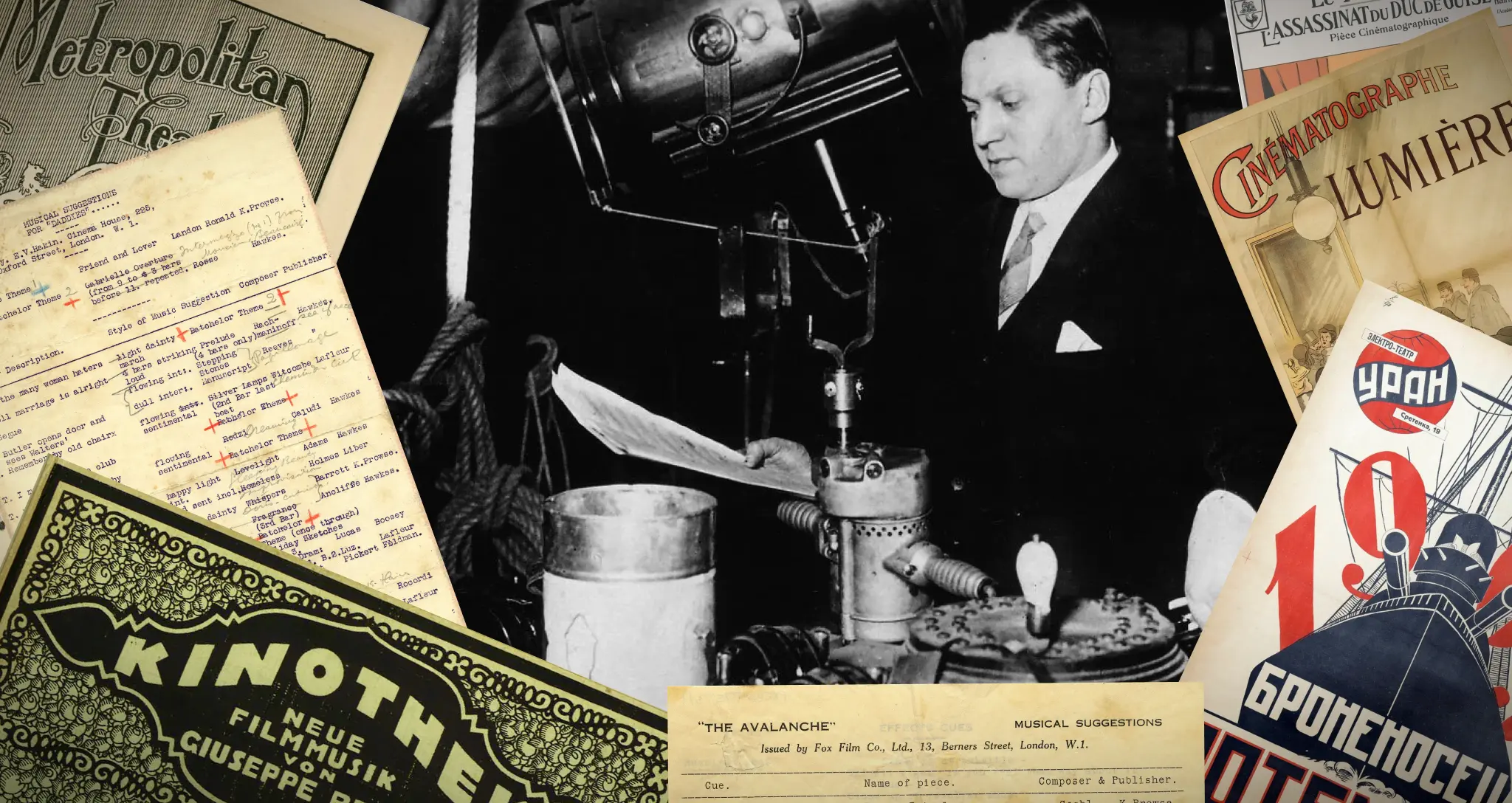
But I’m getting ahead of myself, the Saint Saens score was an exception to the frustrations experienced by directors and producers. London pit bands in particular not only failed to synchronise their performances to picture, banging out random music that had no relation to what was going onscreen but also after rattling through their set would promptly get up and leave the audience to nothing but the awkward rattle of the projector. So in 1909 the Edison company started issuing instructions for how music should accompany the films they sent out to exhibitors and by 1913 pianists and theatre orchestras were able to buy notated music libraries categorised by mood and specific dramatic situations. Kinothek being a particularly famous example of this.
Over in the states a guy called Max Winkler was having an enormous success problem that was specific to this era. Collating thousands of existing works of music for specific use in accompanying films he suffered total paralysis of choice. Infinite dramatic situations, infinite pieces of music to pick. His solution was to create a thing called a cue sheet. By having exhibitors allow him to view films early he would create or rather curate a bespoke catalogue of music with a list of instructions. With visual cues from the screen directing how the music was to be played along to picture. Once these musical recommendations were made by Max, he would of course rent-out all the sheet music assets required to the exhibitors. It caught on, making his solution into an even bigger headache. Of which his only course of action was to turn to out right theft collating and loosely altering copyrighted material for the ever increasing demand. This was an exhibitor’s game, this is pre- TV, this is pre-film as you know it… people were swarming to theatres, the competition was fierce and the manner of a film’s exhibition sorted out success from failure for these picture houses.
His business became a runaway success until sound hit…. Which totally fucked him. He reportedly sold his entire catalogue for $250 all seventy….. Seventy! Tons of it! That’s paper!
But something I think for us came out of this period. The conductors, musical directors of these pit bands, some were more sympathetic and more successful at synchronising a band live to picture. And of all of them this chap called David Raskin was one of the finest. There was one area however in which he struggled to hone his craft with the resources being provided. Sudden changes in music was distracting to the audience, as were sudden changes in narrative which no longer matched the music. The transitions from one piece to another, one emotion to another was where the use of catalogues failed, so he took it upon himself to purposely compose transitions between these pieces, between these narrative switches. To this day it is my humble opinion that a skilled media composer displays her or his talents best by their ability to adjust and transition music where the edit, or narrative arcs betray the tempo, tone, or meter of everything that makes music music. The best composers I have witnessed will be able to handle these changes instinctively and with ease and speed that will outdo any automated or intelligent technology. This for me is where the rubber of media composition hits the road. Where the craft is most honed and the benefits most felt. Not just putting music to picture but SHAPING it.
This is the nuts and bolts but I’m not answering why we actually need it. Here on this hill, with this view. You’re deprived of the depth of field. Where I’m standing it’s 3D. You’re denied the fact that you are engulfing your peripheral vision with this view. It is easy to judge that this is a big fuck off volcanic moment that is tattooed to the landscape. You’re denied your other sense, not the sound of wind from some speakers but the sound of it as it swooshes by your ears. You’re denied the smell of the air. This is mis en scene… where music can help present a scene where the two dimensional, and silent picture falls short. But we can go way further than that, The great romanticist and all out antisemitic wanker Wagner developed the concept, which you can find say in his epic Ring De Nibelung, that music performed an outward and inner emotion. And that when the outward emotion of a scene reached a climax, say a fight, a death, a disaster, that the music should resort more to the inner emotion of the narrative than an outward expression of what the audience was already witnessing or the mis en scene. This for me is where the magic of film music occurs. The ability to tell you how I feel about this view, what it has taken me to get here, what it means for me to be here, and what may be the consequence of the next step I take. This is authorship, the first, second or third person, the narrator, the Greek chorus. It is the telling of the tale. And not just this scene, but how THIS scene bares out it’s context within the arc of the broader story. This is where the craft of media composition is so infinitely complex and is based on your ability to express these often opposing narrative threads through music, through something that doesn’t fit to the cut…. Doesn’t fall squarely into the 16 bars of your phrase, or the tempo of your band. It isn’t just what the music is saying, it isn’t just what the picture is showing, or what the actors are saying, or what the sound design is doing. It is a complex emotional interplay and often counterpoint between all three. This is often where the division between the departments occurs, when a director has made the departments work against each other to create an uncomfortable dissonance to convey something more nuanced and complex.
“Wait a minute, wait a minute, you aint heard nothin’ yet…” Al Jolson’s immortalised words, that occur at 17 minutes and 25 seconds into the film Jazz Singer. Often incorrectly given the attribute of the first film with sound. It wasn’t. The lengths people went to, from hiding actors behind projection screens, insane automaton devices, and electronic, hydraulic and piston controlled organs that were capable of creating not only music, but the sound of a thunderclap, a gallop of horse hooves or indeed the wailing of a police car siren. I mean look at this effects cue sheet. None of this was recorded and then reproduced, it was produced in real-time by someone, against picture! The Jazz Singer more accurately the first Talkie… the first time a commercial picture has contained synchronised dialogue. Ending an era of silent movie making to be replaced with sound and picture married within the specific instruction and intention of the director. It’s arrival was seen as potential armageddon to the artform that had sprung forth and exploded on an unprecedented global scale in just a single short generation. But also an industry that sprung extraordinary wealth but also, unprecedented fame. It made a tramp (as they were referred to then) the most recognisable human being of all time. Not a king, not a tyrant, not an explorer or, invader, an inventor, scholar, or author. But a homeless bum the most globally famous human being who had ever lived. Those who dreaded the arrival of sound feared that the art would be replaced by realism. They were right in many senses. The cameras became fixed for a while, studio bound and contained within sound stages. Music, again for a short time, was called into question, was it needed, now that we could hear the dialogue, the gunshots, the clip clopping of horse hooves. Why have an orchestra clipse the remarkable experience of hearing a door slam offscreen. Was there need for something that will surely become a distraction.
The fear of the death of film music with the advent of the talkie were short lived. As a regular income for pit bands in picture houses it proved fatal. Or indeed the Max Winklers of this world, the music catalogue companies and the dozens of people who maintained, curated and created those music catalogues. However by controlling the re-production of music to picture so sprung forth an immense departmental machinery within the studio system to enable what remained as the essential authoring tool that was music.
Sound to picture was invented before overdubbing. So musicians found themselves employed as part of studio orchestras that sat off camera, waiting for the lights to be set, the scene to be blocked before they started playing alongside the actors as they performed. This created a massive headache for film editors who were suddenly burdened with the trifling consideration of tempo and meter that was now baked into the negatives of their craft.
The hunger for films was insatiable. An industry of just a hand full of studios at its peak were releasing 500 films a year. Hugely complex logistical achievements every single one of them. The talkies didn’t spell the end of film music. Entire buildings with hundreds of staff were turned over to the production of music for these films. Take a look at the departmental schematic for studio salaried music departments. The golden era of film became the golden era of music making for picture. What we provide isn’t a filling of the vacuum of silence. We are not the purveyors of sound for picture. We go into the heart of the story, behind the screen, beyond the scene, into the minds of the characters, the subtext of the narrator. An infinite interplay of melody, harmony, rhythm, tempo, meter. We provide light and shade without the need of lighting or shadows. We can tell the audience what is around the corner, or trick them into fearing something they cannot see. Sergei Eisenstein and Edmund Meisel (pictured in banner above) proved to us the essential nature of music by providing a film maker with one of the most powerful auditory tools for drama. For without music there is no profundity in silence.
And what of the future? Of AI, or generative automation, of the ever incessant insistence that artforms will become democratised through technology. I am suspicious of only one thing. Our complete inability as a species to predict the future whilst being obsessed and certain that we are able to do so. Every technological advancement, particularly in music has been seen as catastrophe. Which has left us behind the curve and at the back of the cash queue with a begging bowl. The only way to predict the future is by quoting history. We have been telling stories through art, through cave paintings, through music and song for millennia. We have been yearning for human connection, understanding empathy and connection for all time. We are still watching performances of Romeo & Juliet, listening to the works of Bach and Beethoven centuries after they were scribbled onto paper with ink and feathers. The arc of human experience is narrated through art. All that remains in the physical realm is evidence of death. By embracing new technology, we embrace new ideas and discover new forms of expression, of conveying those stories, but more importantly our feelings. Have no fear of change for me art is at its heart an expression of the profundity of love. And as long as we have love in our hearts, we will strive for, and crave art, because it is the closest thing we have to represent it, preserve it and remember it.