
Or as a business person on a vlog I watched once said, “there are no bad ideas, just badly explained ones”.
But this was a shit idea – quite literally. Its one of those things where people you know, know what you mean. But conveying this to people who don’t make music, or rather don’t make music the way I make music it’s a different matter. It just sounds… well a bit silly…. a bit pointless; To take a bunch of unfashionably bad synth presets, make them worse than their factory birthday suits, employ a disastrous signal chain and a specification for sampling that wouldn’t earn you a place on a giveaway DVD stuck to the front of a music technology magazine in the late nineties. The thing is, great sounds can make us all lazy. As people from my corner of the music industry often say when pressing down one key of a complex and evolving pad “thats a cue in itself”. One key wonders, preset hounds, it writes itself. All utterances we’ve heard or orated. It doesn’t take much to stir something if you just sit at a nice piano in a nice room. There is so little emphasis on needing to come up with a composition that turns the screw and makes people feel something if what you’re starting with as a raw material is already beautiful, complex, epic or awesome.
Bertold Brecht was, as I understand him, a director who believed in theatrical performance that was bereft of “theatre”. The scenery and space his performers occupied was sparse and austere. The style of performing was far from emotive, it was by all accounts almost monotonal. It was a way of purifying the presentation of the text down to its rawest form. If the words didn’t do it for the audience, fuck if anything else would. It tied in with the minimal, brutalist, bauhaus art and design forms that accompanied and followed. It snuggled up against the avante garde that led to paintings of nothing but a single colour, or no colour at all, it led to music becoming…well, anti-music. Forms where melody, harmony, tonality even any sense of meter was sneered at. The 1952 piece “4:33” by John Cage with nothing but 4 minutes 33 of total silence was perhaps its zenith even if we had to put up with the emperors-new-music for many decades hence.
I share the opinion of one of my favourite composers John Adams who has often intimated that music of the mid to late 20th century was a bit crap. I would put it; awful but a awfully necessary. I see the centuries that ushered in the 20th as a continuum that found all the colours of the rainbow to paint sound with. The 20th century was simply the last addition to that palette, all the greys, the blacks, whites, and I would say in the case of John Cage, the colour transparent. A sonic paint that couldn’t be heard, seen or smelled. Without these colours and concepts our music and we wouldn’t have the artistic freedom everyone enjoys today. So we’re better for it I think… but there were some long nights I had in empty concert halls that I wouldn’t care to repeat voluntarily.
If you wind the clock back to the original music minimalist, or “Gymnopédist” as he abstractly referred to himself, Erik Satie. His haiku like ambient pieces say so much, can move you to tears, stroke your ears gently or prick up the hairs on the back of your neck. All done with remarkable succinctness. So few notes, over so little time (his works are unburdened with bar/measure lines incidentally). The reason his (revolutionary at the time) simplistic pieces do this are because the notes and the order he put them in are a really good choices. They feel meticulously scrutinised in their composition and strangely perfect even if the modality and tonality is alien and surprising. But also for the performer, the subtlest pause, change in dynamic, acceleration and decelerations in speed, become unusually poignant expressive statements. They are incredibly powerful pieces to play, as every interpretative gesture is one that can carry so much weight and effect.
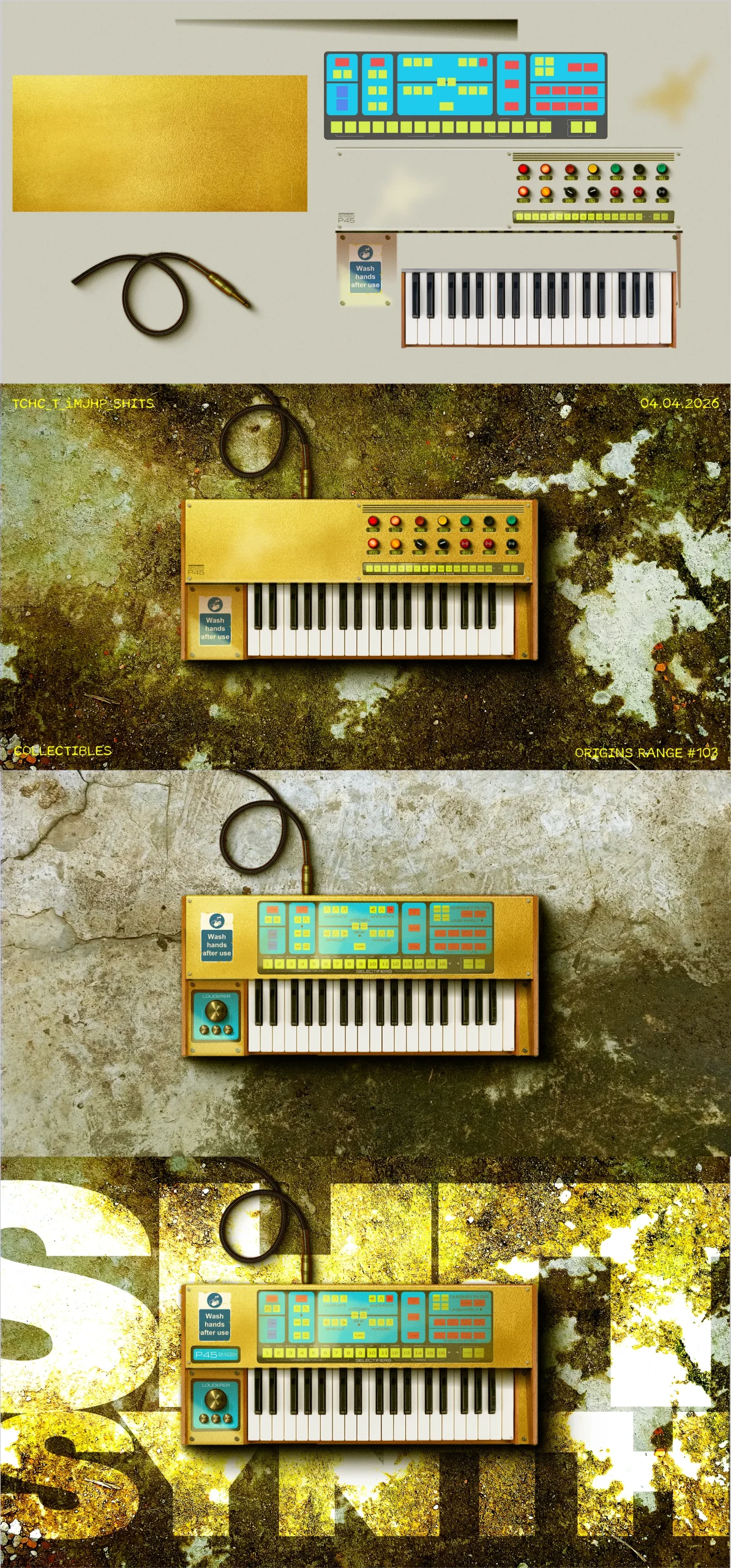
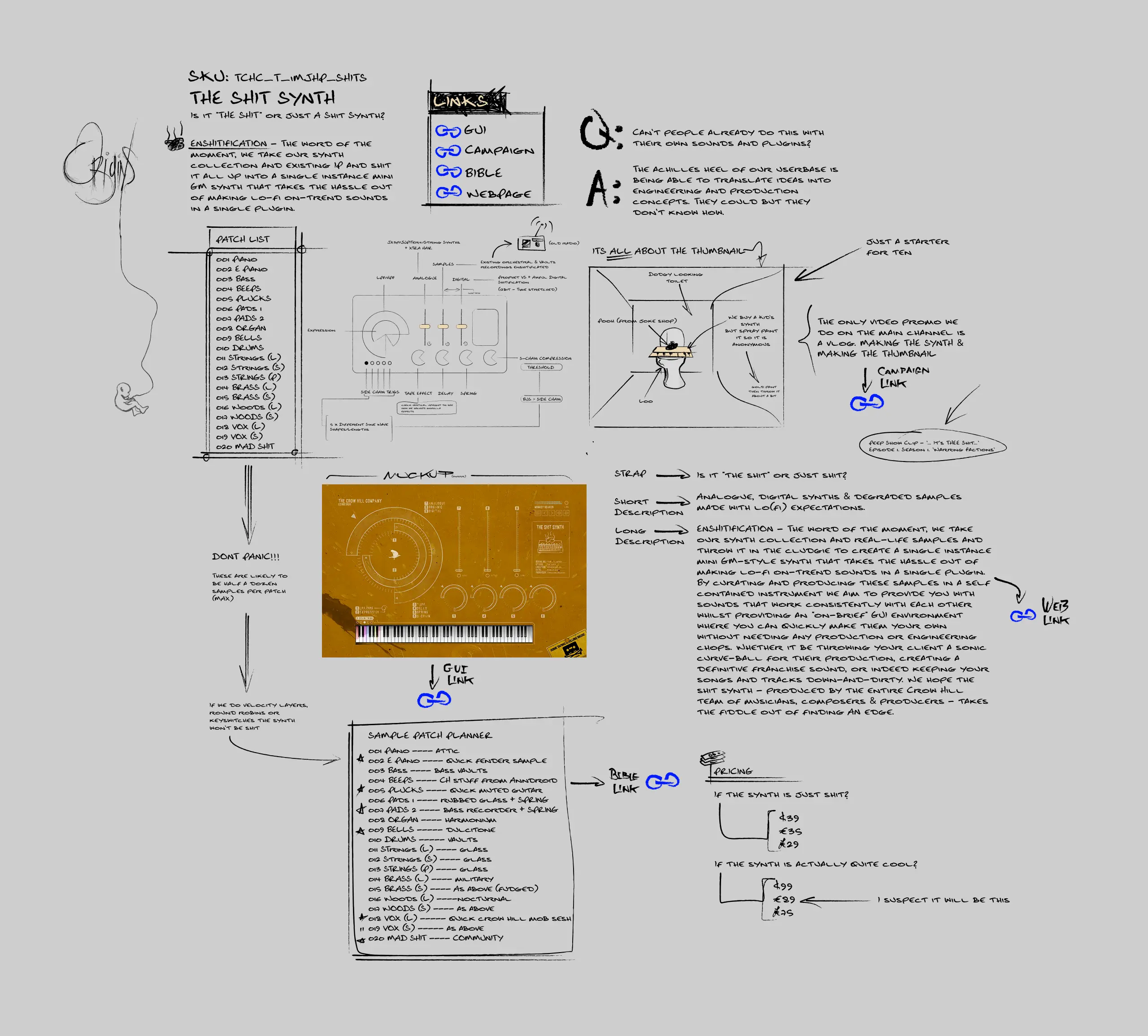
So, when building this “shit synth” I wanted to create a set of sounds that were less post-modern-ironic (as the name would suggest), but more simply a set of instruments that encourage me to mean every fragment of music I write. The type of sounds that create a rubbing sonority with every note, pairing or triad. The kind of sounds that accentuate the choices you make, expose the care and attention (or lack thereof) you have afforded the compositions you present. Something honest, unashamed, primitive, unusually poignant, and ultimately… a little bit shit.
CH.