

Wine glasses sound lovely because they have a metallic like crack and a series of sine-like decaying tones that self oscillate because of slight differences in tuning across several pitch centres with a clear fundamental pitch in every glass.
Problem #1
wine glasses aren’t musical instruments and have one pitch ‘centre’ so we rely on the magic of sampling to make a scale out of them. However…
Problem #2
whilst played on a single note they have a magical and beguiling sound. however when sampling or using something like water to pitch them up or down these secondary harmonics remain consistent in intervals relative to the fundamental.
this means the minute you change notes from the tonic in any scale the wine glass will immediately play the wrong notes for the scale.
Transients
A dense collection of frequencies with a broad bandwidth that form a transient attack and die away very quickly. as the harmonics are so dense this forms a metallic atonal ping.
Fundamentals
A clear object ‘mode’ that oscillates louder and longer than any other frequency of the glass. sine-like in quality with a slight oscillation in pitch
Harmonics
3-6 pronounced pitch centres (usually one is one or two 8ves higher than fundamental) that have roughly half the volume and half the length
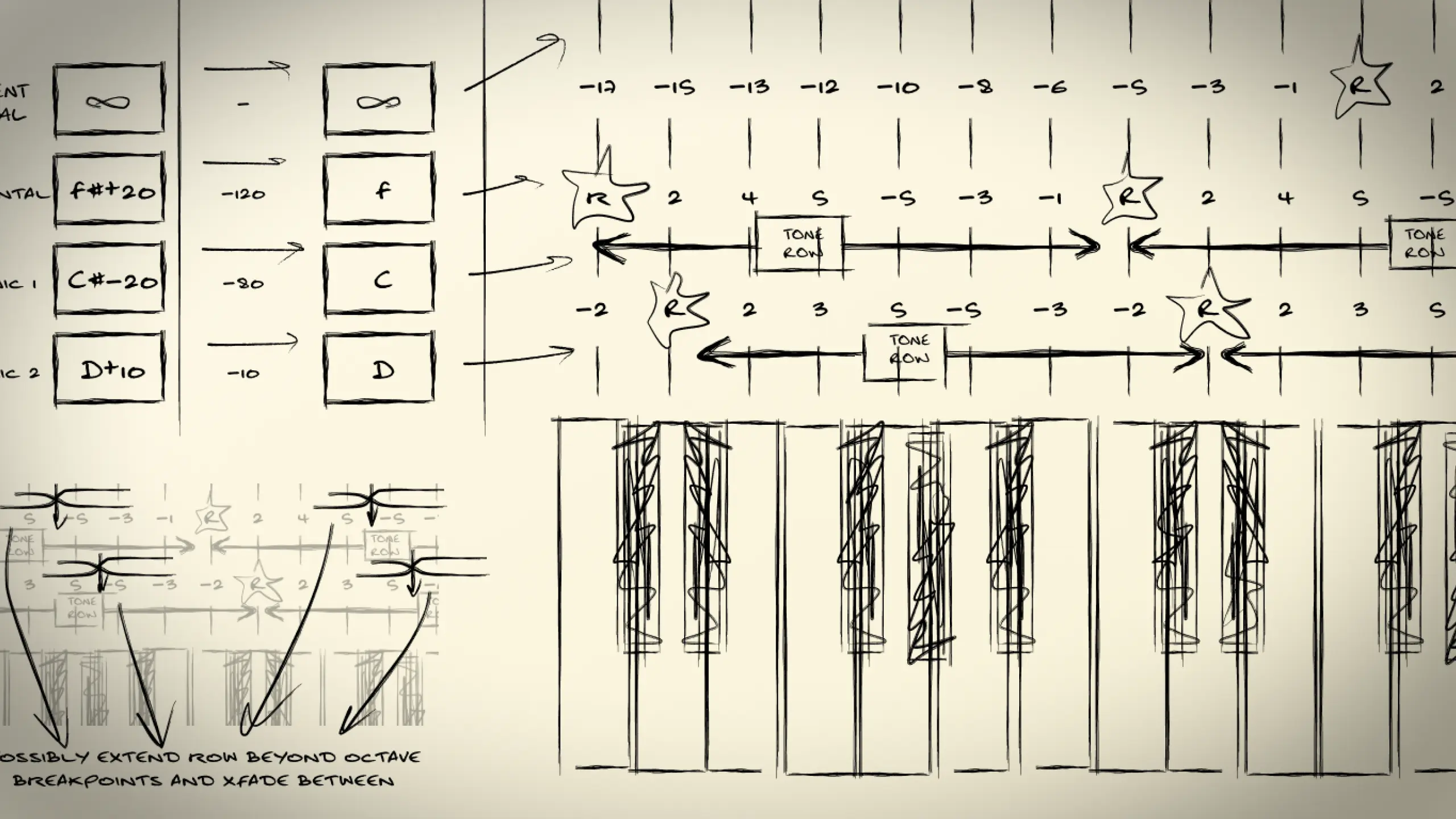
These elements can be separated using RX, treated & implemented separately then multiplexed into a single sample instrument.
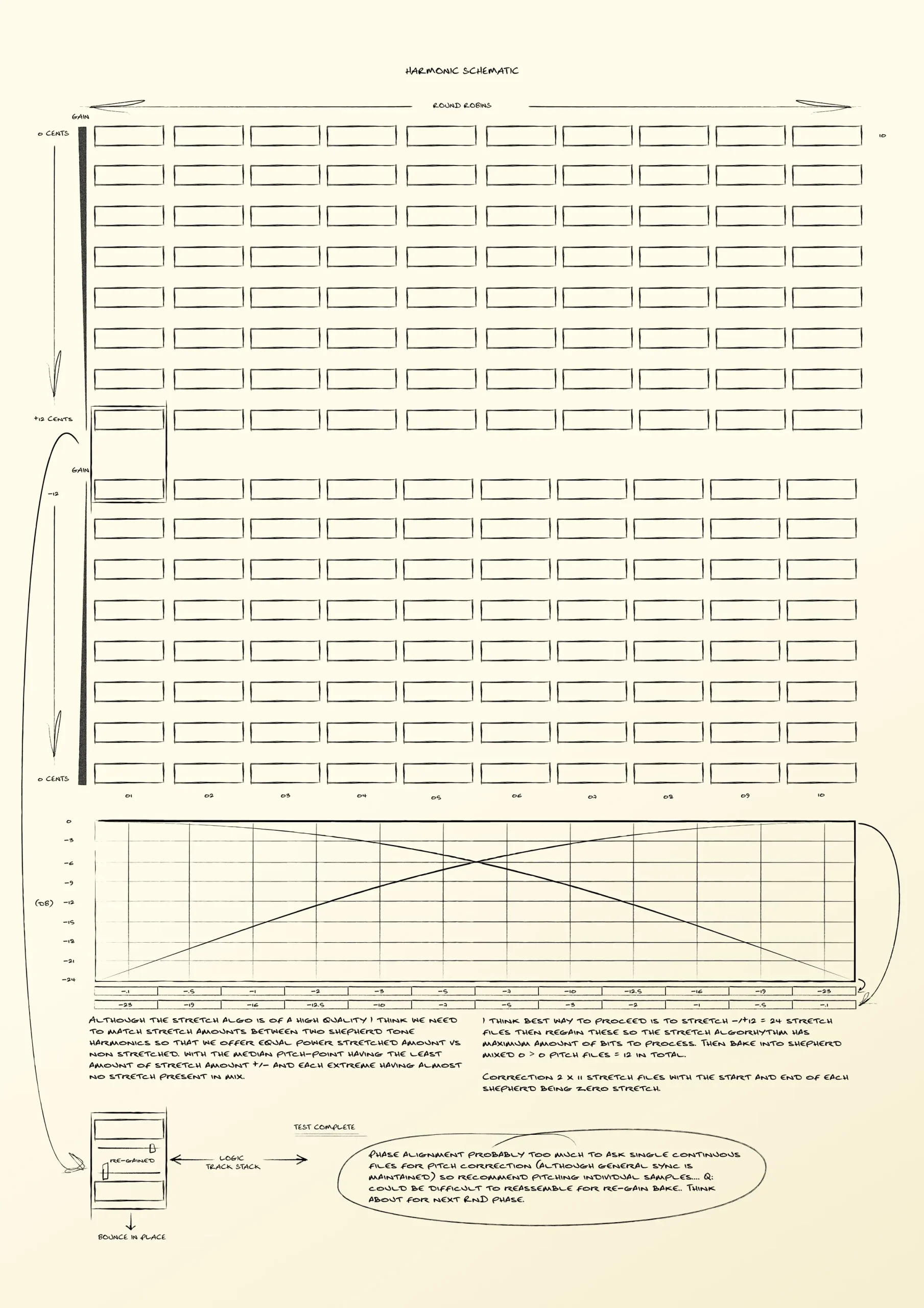
Although the stretch algo is of a high quality I think we need to match stretch amounts between two shepherd tone harmonics so that we offer equal power stretched amount vs non stretched. with the median pitch-point having the least amount of stretch amount +/- and each extreme having almost no stretch present in mix.
I think best way to proceed is to stretch -/+12 = 24 stretch files then regain these so the stretch algorhythm has maximum amount of bits to process. Then bake into shepherd mixed 0 > 0 pitch files = 12 in total.
Correction 2 x 11 stretch files with the start and end of each shepherd being zero stretch.