“Sounds a bit GM doesn’t it”
…was an even greater insult that being accused of being a “preset monkey”.
It’s the ‘90s and a revolution was underway. One that left commercial studios, quiet, “dark” and facing bankruptcy. Music making had suddenly moved to people’s bedrooms, front rooms and “project studios” around the world. A spirit of adventure, invention and “home made” surrounded this revolutionary movement. Within this community a disdain of using sounds that were factory shipped was fervent as it belied the spirit of DIY music production. Everything should be made, programmed and produced from scratch (or sampled directly from records) by disruptors, DJs and composers who, for the first time, not had the benefit of a formal musical education, theoretical knowledge or indeed any need for musical notation or electronic circuit diagrams.
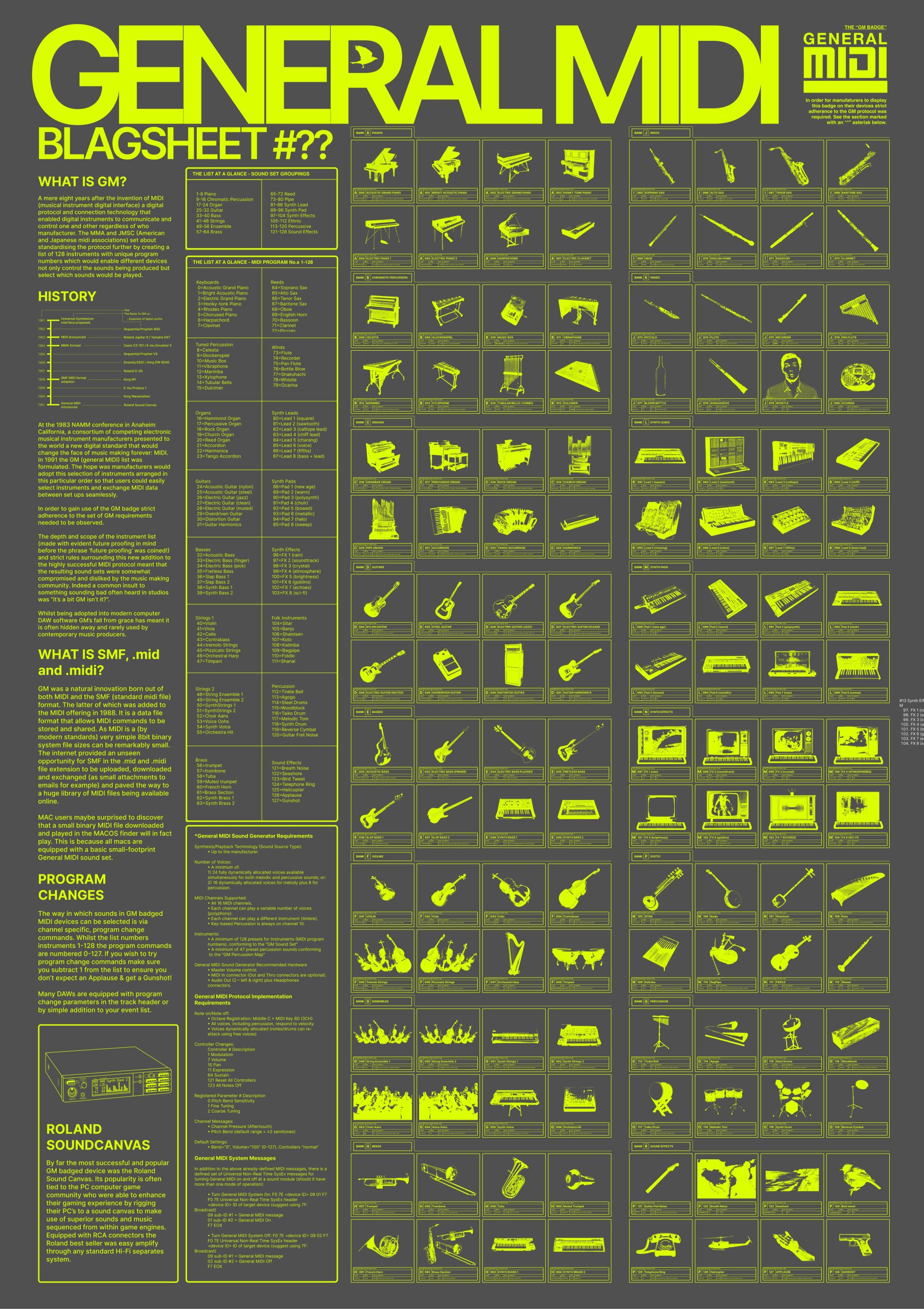
The innovation that had precipitated this noisy revolution was the introduction of MIDI, musical instrument digital interface. A rare thing where competing manufacturers gathered and quite remarkably, agreed on something. A means in which devices could be connected to communicate and control each other with total agnosticism to whom had made them. Announced in 1983 at the annual NAMM conference. MIDI changed everything.
The advent and universal employment of MIDI paved the way for the dominance of computers within music production which further accelerated the democratisation and renegade spirit of music production.
However, this huge disruption to the music industry at the hands of the MMA (MIDI Manufacturers Association) developed an attitude and approach to music production that would almost guarantee the abject failure of a further development in MIDI; General MIDI.
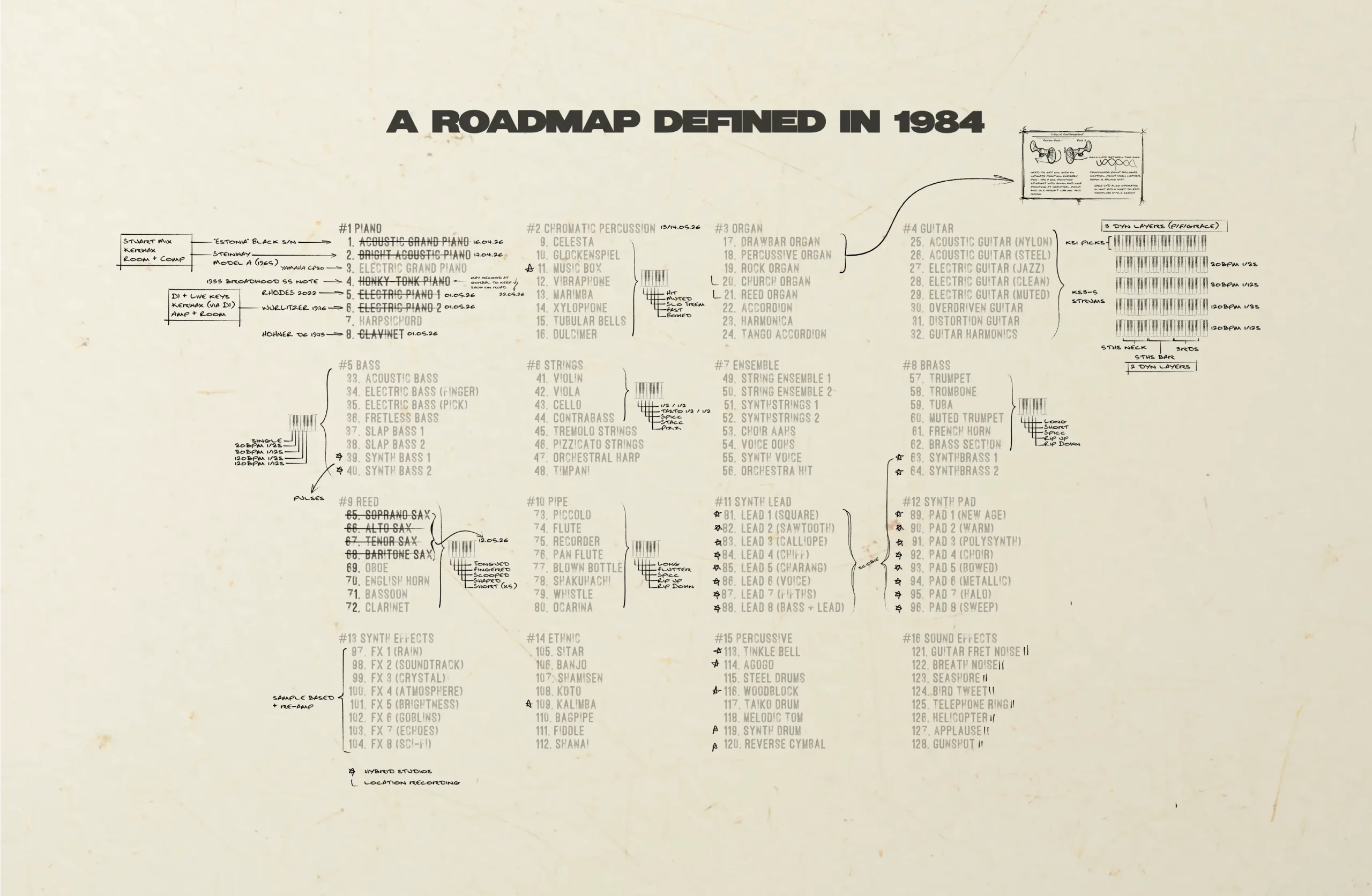
A list of 128 instruments designed so that not only notes and other controller data be transmitted, stored and transferred between devices, but with the introduction of “GM”, sound selection too. It seemed like a natural evolution of the protocol. But to many felt like an unnecessary overstep in the level of “control” and “conformity”. Moreover, who picked this list? Who determined what instruments would be worthy to make Noah’s ark of 128.
Case in point; this being the 1980s meant that of the 128 precious slots 4 were sacrificed to saxophones, and 2 to slap bass.
It would take technical advancements beyond those available in the late 80’s – namely sampling technology – to make microchip controlled instruments sound realistic. So GM devices and their inherent implication of encouraging users to rely on factory made presets were always going to be lambasted for their ‘lame-ness’. Which is why accusations of something sounding GM became the worst of all insults in the ‘90s and why the badge – despite the immense efforts any manufacturer would have to adhere to obtain it – went from one of honour to one of ridicule. If people saw the dreaded “GM” insignia on a sparkly new piece of kit it was to be avoided as the very antithesis of street credibility.
Having inexplicably (or as I prefer to borrow from Withail & I) become a music tech entrepreneur “by mistake” I feel that I have contributed to this renegade kit-car nature of making music. Whilst I will never shy from expanding on my desire to create and develop sounds that break all rules of sonic production and performance. That music production homogeny should be avoided at all costs, and the best way of achieving that goal is by having choice…. Masses of choice. I do feel that I have in some way contributed to entry into music production being a totally mystifying ocean of choice with alarming peaks and troughs in quality. Whilst I feel my attempts at making orchestral music more affordable and more accessible with my Albion concept and more inclusive and welcoming with my LABS invention were a success. I have been thinking for some time now that these two decades of sampling experience could be used to make music production more appealing to a broader spread of musicians, music makers and enthusiasts. Ones that maybe don’t want to approach it with this kit car mentality.
I think making music, particularly your own music is one of the greatest natural highs, most positive escapes and restorative things a human can experience. To go through life and not experience it I think is a betrayal of the gift of life. I really mean that. I have always wanted to remove the gate keeping and barriers to entry for any human to experience it, particularly those without the means and support around them to consider it.
After covid I met up with numerous people who thanked me for inspiring them to have a go at making music. How much it had helped them get through the pandemic. How much it helped them escape their torpor, put the self harm and thoughts of suicide off for a bit, how it made them have that first drink of the day an hour or two later. This was the only encouragement I needed to set up Crow Hill. Whilst the impact of my YouTube channel and the free instruments I was involved in making and distributing was an utter tear-inducing surprise time and time again. The impact on people of making music, their own music was no surprise at all to me. It is one of very few human exploits that you can perform for hours a day, every day, all year round without causing yourself harm (provided you keep an eye on your monitoring levels). So as an absolute cornerstone of Crow Hill, from the get go was the idea of UGM (which we abandoned as an acronym as it sounds like a fairly awful company with also has an m-for-music in the name).
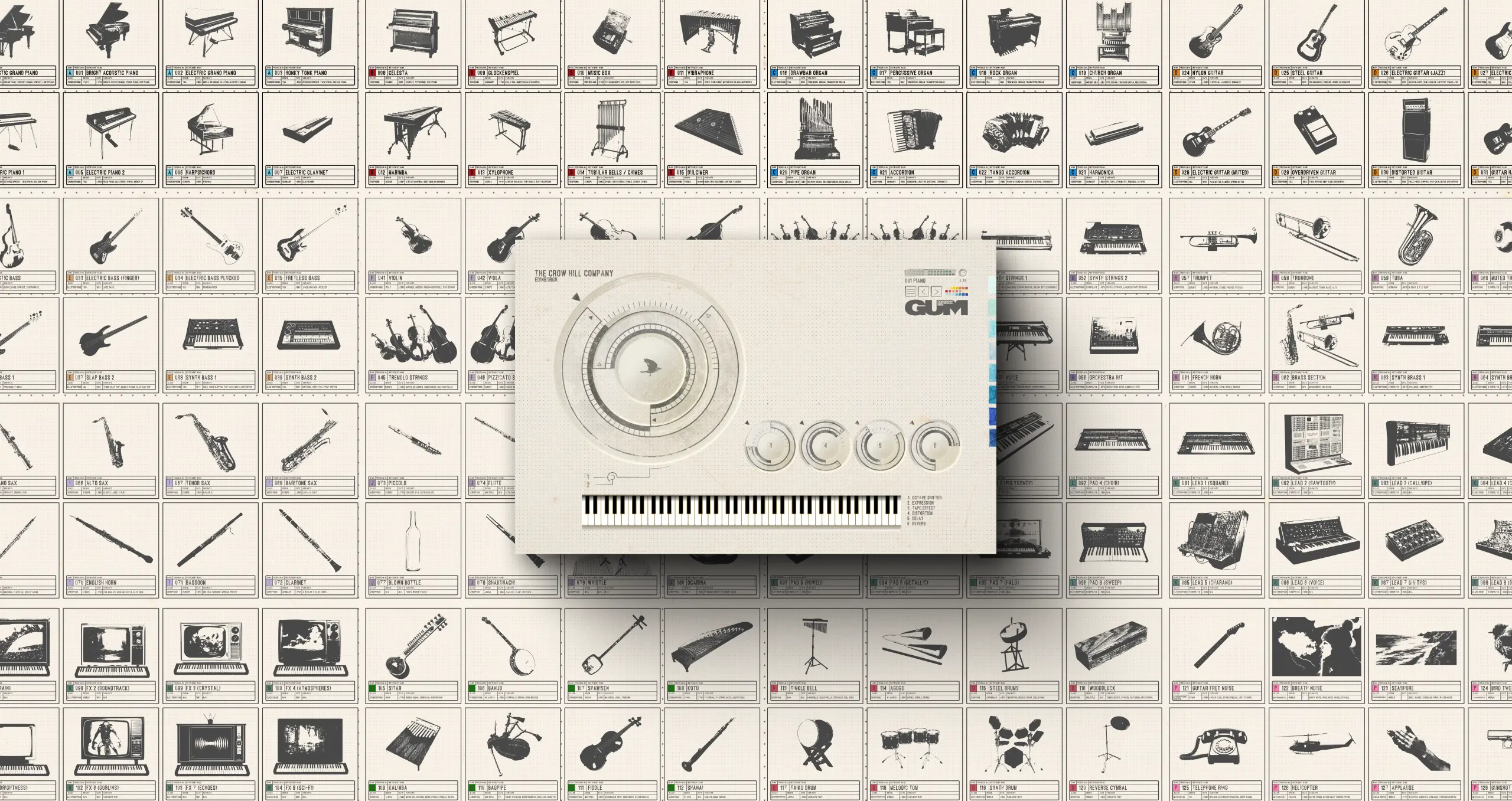
What if we were to make a sample set to get people started. That provided professionals with a pantry of essential sounds that were consistently good, reliable AND inspiring. That everyone can use and stick on their hard drives so anyone, on any system, using any DAW can share ideas, learn from and inspire one and other just by exchanging midi files. But also, using all of my experience in making samples to prove that the worst idea to come out of MIDI could actually be brilliant. What if we were to make GM sound gorgeous.
Which is how we came up with GUM… Gorgeous Universal MIDI.
There’s something to be said for restricting one’s resources. It makes us more resourceful! The same can be said for making something lean, simple, easy and brilliant to use. It requires more affectionate planning and decisions from the get go. Feature rich, massive sample libraries require immense effort and resources in post production. But I think they are lazy in the planning pre production and production stages. There is a grab everything and design it for every possible eventuality; known and unknown. These types of software are either designed by people who don’t make music, particularly not as a career, or if they do so they sit firmly in a small minority of people who have time and a keenness to tinker as much as make music. GUM isn’t that. It’s for people who don’t want to break their creative flow, for people who want to reach for sounds knowing that they will be good, not having to spend hours scrolling through endless preset lists to find that bottle-blow!
So planning and curating this has not only been daunting (I mean 4 saxes and two slap basses come on!) but difficult. For me it is going back to the sample-instrument drawing board and removing all of my experience as a professional in their operation. I centred in on three rules which, and this is where it gets difficult, because they kind of all work against each other.
1. Realism through character
2. Universal use regardless of ability
3. Shouldn’t sound like shit.
1. At Crow Hill we’re making a name for ourselves by pushing the acceptable edges of sample-practice. People are liking what we are doing and are signalling that our direction of travel is a welcome one. However with character comes character flaws. Pianos serve single purpose, quirks can get tiresome and not have a “workhorse appeal”. But most of all there is always a learning curve with such instruments. They don’t play like others. Again using the piano as an example, would a piano that sounds awesome when playing a piece by Satie or Olafur Arnalds, sound just as good when playing a piece of Rachmaninoff or Dario Marianelli?
My solution was to investigate the Haas effect. The problem with “universal instruments” is they are often recorded super dry, super clean and take production chops to bring to life. Conversely instruments with a lot of room will always carry a distinct sonic character that is difficult to truly make one’s own. The point of GUM is not to imply how it should be used, or the genre you must play. It needs to sound like real instruments making air move in a room that resembles a room, not a padded cell for lunatics. But it also needs to work on any style, for any application and for all abilities and levels of experience.
2. So with GUM it just needs to play. No fader movements, no weird mappings, no fancy controllers, one mode of employment for this sound, another for that. With gazillions of MIDI files online these should work on GUM! So they have to JUST PLAY!
3. Why do general-style instruments just sound awful…. Or rather, why do they sound nothing like the records we listen to? I get it we can’t afford the budgets of say XXX or XXX but surely as a sample company a similar amount of love care and expertise could be employed so that the end player can be transported into a world of pro-end audio and sounds. That pros themselves can use as a faithful resource of record-ready sounds. Which is why I have personally curated every aspect of this library to find the right balance between character, attitude and usability. The right amount of room to stimulate your Haas reaction (the thing in your brain where and instrument is not just what it is) and give a sense of the air around an instrument being recorded not the instrument itself (which isn’t how you hear stuff). Making sure that each performance led sample is just that, part of a performance not a scientific capturing of a note. And that the correct amount of depth is employed in their capture. Dynamic layers adjusted to suit the instrument along with round robins, release triggers and resonance samples (ie pianos where the strings sound differently when the sustain pedal is depressed).
I don’t want to take any more of your time by talking about pricing structure too much. But I wanted to appeal to the mavericks, risk takers and faithful followers first, get them onboard with a gesture of thanks. But also a sense that we’re are bucking the trend of a race to the bottom with prices, our efforts and our investments. So from the get-go with GUM we put have it out there early so people can help us shape the eventual outcome, inform us if we need to change or redo something. But also for the value of the project to appreciate as it grows towards the full list of 128 instruments.
But most importantly I took a leaf out of the book of a great hero of mine; Lou Otten’s, inventor of the tape cassette who convinced Phillips, the people who employed him, to make the cassette free of any licenses to manufacture and distribute. With the simple but compelling statement “if you want it to be universal, it has to be free”. So we have carefully stripped GUM down to an accessible version for all to use for free which also… crucially… doesn’t sound like shit.
I have ambitions beyond the 128 instruments though.
I would love to be able to join and be part of the MMA
I would love to get the GM badge (but know we have a lot more technical hoops to jump through to achieve it)
I know to achieve this we also have to create a drum kit module that sits outside the 128 sounds…. I want to make one that is worth people’s hard-drive space as there are so many excellent ones already out there.
We are yet to work out how to do this. So my final entry in the “ambition” portion of this essay is to eventually make all the recordings available as raw .wav files. So that if we ever make poor business decisions and things go south, people aren’t left high and dry, but have the capability of rebuilding stuff in the future.