My top ten films about film making. CLICK ON TITLES TO FIND WHERE TO WATCH.
10. Jackie Chan – Incredibly Strange Film Show
Whilst there are many films about the great Buster Keaton — a great actor, a great director and possibly one of the best physical performers of his time — we are denied the insight into his work that we are used to in this modern age of the DVD extra and people filming people filming people. So I’ve settled for an eye-boggling movie by his greatest fan, greatest student: Jackie Chan. A martial artist, actor and director from Hong Kong, who is the only performer to get even close to Keaton for his sheer daring, risk-taking and many onscreen injuries. A master of the craft of combining stunt work, martial arts and choreography into a canon of work that is denied us all in this era of CGI.
The artifice of filmmaking, of stunt work, of fight sequences and physical performances never fooled us. But it gave us the circus-like entertainment of going to the movies and watching a stunt double, or an actor on a wire with an off-camera landing mat beneath them, fool us — do stuff we wouldn’t dare. Amaze us by their physical abilities and technical inventiveness.
This documentary is a testament to that lost age and something I’m certain younger generations will be flabbergasted by, when realising that these things — people, stunts, dangerous moments — were not painted in, but planned and executed in real life.
9. The Pixar Story (available to rent on all popular platforms)
What made Steve Jobs so great? Well, there’s a moment when he changes the make-up of a boardroom of an incredibly famous cultural leviathan of a corporation that will leave you aghast. What did Steve Jobs do when he left Apple? He did this — and it is a testament to his unique business acumen and understanding of what makes creative people tick that enabled the formation of one of the most successful animation studios of our time.
Pixar was to animation what the Wright Brothers were to the car industry. A new technology, a new breed of creative, and a new culture built around it by an individual who knew how to motivate people to think different and create modern masterpieces that would permeate through culture globally.
8. Filmworker (available to rent/purchase on Amazon, BFI and Apple)
Whilst there is no denying the detailed and fascinating account of Kubrick’s life in pictures in the documentary of the same name, narrated by none other than Kubrick’s last leading man, Tom Cruise, it does belie the complexity of Kubrick as a human and how that obsessive nature led to a canon of films that bear his name and a style of filmmaking never before attempted, and never to be allowed to happen again in the future.
This is where this extraordinary film comes into perspective. The biopic not of Stanley Kubrick, but his personal assistant Leon Vitali — a striking-looking, promising young actor who becomes beguiled, besotted, then obsessed and then dedicated to serving his master and his master’s work like no other. The destructive force of the culture Kubrick built up around him is borne forth shockingly in how much Leon is transformed from this young angelou of an actor into the emaciated form presented before us.
If this film doesn’t send you down the Kubrick rabbit hole, no film will. But I humbly recommend you watch this before any of the documentaries on Kubrick. The narrative arc of obsession is riveting and the glimpses we get into the culture and workflow of one of the most private legends of show business should make thankful viewers of all of us.
7. The Making of Ben Hur
Don’t be off-put by the slightly dated PBS-style delivery of this documentary. From a historical perspective this is pure gold, with one of the most “fuck off” shots in silent movie history. Yes — they tried to make Ben Hur several times.
A theme of this list is that of something that has always befallen the movie industry: to turn a dramatic form into a Herculean task. There is no precedent before or after for Ben Hur — on-screen fatal accidents, insane racism, spiralling costs. Ben Hur should have been a lesson learned, but instead (probably due to its box office success) made for a template — which is where much of the rest of this list will follow on from.
6. Dicks
“A poet needs a pen, a painter a brush, a director an army,” said Orson Welles, apparently… he was a total dick.
Narrates Max Joseph, the director of this YouTube mini-masterpiece that discusses the culture of narcissism — or “dickishness” — that surrounds the job of a director. Hot off the back of his directorial debut, Max reflects on how surprised he was that it wasn’t the smooth run he’d hoped it would be. By being nice to the cast and crew, he didn’t get what he needed and felt what he was left with wasn’t the film he was trying to make. He asks himself: did he need to be more of a dick?
This is a YouTube heyday movie — when anything that ran more than ten minutes was considered a non-idiomatic indulgence. So it goes at breakneck speed, covers a lot of ground and has a host of excellent contributors who Max has cut into pithy sound bites. Max is clearly a fan of Nick Broomfield, so in this short documentary not only does he get to the bottom of his question, he also documents how difficult it is to make this documentary — particularly where one notorious “dick” is concerned.
As I said, a mini masterpiece and a useful treatise into narcissism and how we should learn to expect it when working in the movie biz.
5. On the Edge of Blade Runner
There are several documentaries surrounding Ridley Scott’s cult-hit sci-fi-noir Blade Runner. But I would say this is my favourite. Made by film critic Mark Kermode, it is clear that he understands what a Blade Runner fanatic’s needs are — and he meets them.
There is nothing about the making of this film that would lead you to believe in the result that is achieved. It seems that no one making it believed in it. No one liked one another. No one respected each other’s work. I mean, look at the number of cuts and recuts — they display the director’s own frustration with this unexpected masterpiece.
The one hero from the piece would be Rutger Hauer, whose professionalism had him dive headfirst into his role, pen the often-quoted purple passage he recites before his character’s demise. He seemed to get it. He seemed to know just how special this film was going to be. Mark Kermode, in directing this, is clearly a devoted fanboy — and he does it a good service.
4. Lord of the Rings Trilogy DVD Extras (8–9 hours, available on Amazon and Apple)
When a fan — well, not JUST a fan — when a superfan fights tooth and nail for the rights to direct a franchise of one of the most ambitious, successful and beloved rites-of-passage literary masterpieces in the history of books, the result is the first set of films that provide true fan-service.
Peter Jackson knows the obsession that lays behind these books and the cultural impact they have had. He knows that people, young and old, from all backgrounds, have in their mind’s eye an image of Frodo, of Bilbo, of Gandalf.
So what you get in return for this degree of fanaticism is a hobbit-like feast of extras never before attempted with a film franchise and never delivered on again. The extras amount to more screen time than the movies themselves — and that is truly saying something because the films go on a bit.
Every detail about the production, the design, the building of an infrastructure in New Zealand. The actors’ journey, the director’s journey, the journey of the emerging technology. Jackson takes us on that journey. For anyone wanting to break into the film world, you’d do worse than to watch this film. After six-odd hours of extras, you will be more familiar with the lexicon that surrounds the business you’re getting into. That — and the degree of commitment, obsession and innate madness you’re going to need to survive it.
3. Aliens: Behind the Scenes
One of two James Cameron films to feature in this list. You’ll spot a pattern here — a director so incredibly driven that he drives his cast and crew to oblivion.
The task? To create a follow-up to the seminal horror masterpiece Alien — a director’s movie by a director’s director. Who steps up to the plate? James Cameron, hot off the unsuspected success of his low-budget, pulpy Terminator film. He has proven box office success — but can he prove himself a reliable director when his pockets are bunged full of studio cash?
You be the judge. His insane drive, devotion, but also indifference to local traditions, means his style of working very much butts up against the slightly more jobsworth approach of his English crew. Needless to say, you won’t find a tea trolley anywhere near a James Cameron set since shooting this.
The result is an extraordinary follow-up which pivots the franchise from horror to action — masterfully, albeit without making many friends at Pinewood Studios. One of the true highlights of this documentary is the account of the scoring process with James Horner. His unusually candid account suggests that the difficult shoot in London was just the start of the journey.
With a running time of nearly 3 hours, this documentary is ideal rainy-day-with-a-hangover fayre.
2. The Abyss: Behind the Scenes
If there are two films I’ve watched more than any other, they would have to be this one and our number 1 selection. An official member of my “at least once a year” film club.
It is an astounding and resoundingly unique account of one of the most unique, extraordinary and downright absurd film shoots of all time. Imagine filming a science fiction film not in space, but under the water. Well — under a tarpaulin, under several million black floating balls, in the biggest tank of water in filming history, under chlorinated water which will turn your hair white, in an abandoned nuclear power plant, without any oxygen, surrounded by an entire crew also underwater, who have no idea you’re drowning to death.
This is just one of many harrowing experiences the performers share about a movie directed by James Cameron (yes — the second documentary about this loon). You have never seen such trauma suffered by actors, technicians and two unsuspecting rats. I won’t say any more. This has to be watched to be believed. A remarkable hour or so of documentary that will have you rewinding and watching again and again in disbelief.
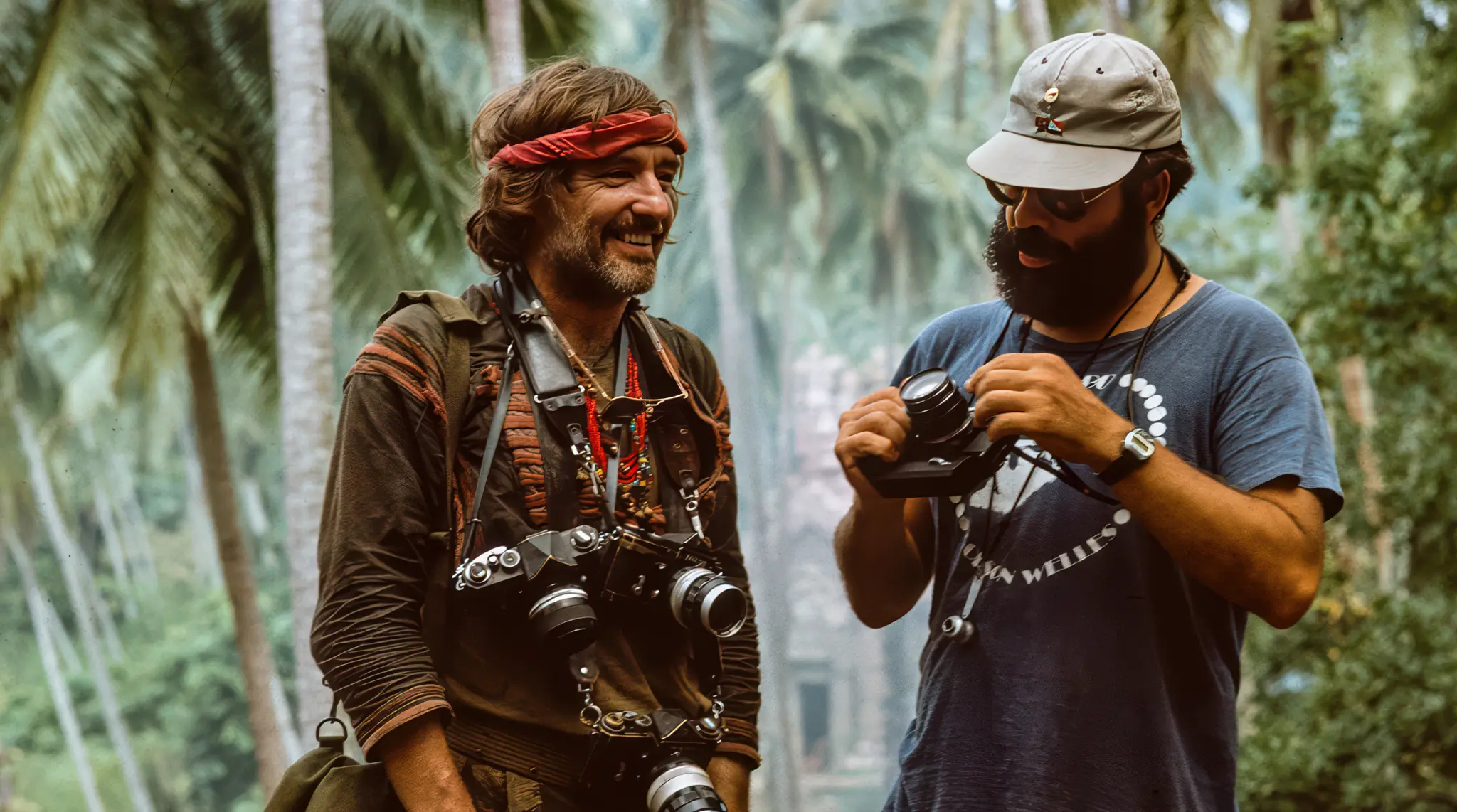
1. Hearts of Darkness – A Filmmaker’s Apocalypse (also available on Apple TV)
There is no greater documentary about the making of a movie than this. It is a warts-and-all account of a gargantuan project that goes wrong on an unimaginable scale.
In 1976, Francis Ford Coppola, flying high off the success of his two masterpieces The Godfather Parts 1 & 2, sets off to the Philippines to make his take on Joseph Conrad’s Heart of Darkness — an adaptation that had already got the better of Orson Welles. Coppola’s take on the novella was to set it during the Vietnam War (the Philippines being elected to play proxy).
It is beset with problems from the start — when two weeks’ worth of complex filming is scrapped in order to replace Harvey Keitel with Martin Sheen. Hurricanes. Disappearing military aircraft. Pilots fighting a rebellion in the north of the Philippines. An overweight and overwrought cameo by an overpaid Marlon Brando. Drugs. Egos. Heart attacks. You name it — it befalls this production.
But at the heart of the disastrous shoot is Coppola himself. With huge personal wealth, he creates a perfect storm of narcissistic nihilism, with an ever-flowing supply of money to satisfy his every whim.
What makes the film extraordinary is the totally unique closeness of Eleanor to Coppola. Being his long-suffering wife, she shares a candour with us viewers drawn from being by his side during his darkest hours — when the crew is sleeping and the door to his temporary accommodation is closed. But more so, her intimacy with him enables us to understand — through her — his state of mind and motivations better than any documentary filmmaker could imagine.
Drawn from her contemporaneous diaries (a must-read for anyone interested in filmmaking), footage she shot behind the scenes on a Super 8 camera, but also some clandestine recordings she made when Coppola went into one of his many red-wine-pasta-and-opera-fuelled rages.
It is directors like Coppola, Welles and Cimino whose auteuristic desires repeatedly brought Hollywood studios to their financial knees that ensured films were never to be made in this manner again. This film is a rare historical artifact of a bygone era — whose demise was authored by its champions.