CLICK ON TITLES TO FIND OUT WHERE TO WATCH…
11. George Harrison – Living In A Material World
Scorsese flexes his extraordinary ability with forming narratives in documentary form. This extensive life study of George Harrison is a true picture of how life sustained in the music biz can be ones of highs and lows. It also offers a rare insight into being in the Beatles. Being subordinate in his freedoms to expressive himself artistically when working in a band that has Paul McCartney and John Lennon in it.
10. The HipHop Years
This is a seminal series that corrects the many assumptions you may have on the origins of Hip Hop. The well-researched historical document that describes what is, in fact, several different music forms converging into a single subculture will leave you corrected, astounded, and full of admiration for the birth of a truly new art form which some of us old codgers got to witness, albeit from afar. However, astonishment is mostly reserved for the contributors sitting in front of the cameras themselves going, “I had no idea.” This is a direct reference to a true highlight of the film when Gary Numan is informed that his music played a crucial role in the development of the form.
9. The Greatest Night In Pop
Quincy famously (didn’t say) “leave your egos at the door.” That is a conflation of another studio anecdote from Jones. However, this documentary of a master at work—dealing with a half-cut mob of insanely famous, talented, and rich artists, all half cut, recording a charity record through the night straight off the back of an awards ceremony they were attending—is remarkable. Highlights include the shorthand that he and Michael Jackson slip into, which puts everyone else to shame; Bob Dylan’s sheer incomprehension of where he was or what he was doing; and how Quincy demonstrated that one facet of a world-class producer is often patience! There’s also a wonderful moment when a shy and nervous Huey Lewis, flanked by some of the greatest vocalists of that time, smacks it out of the park and demonstrates why he gets to stand where he’s standing on that long night.
8. This Is It
Whatever your views on Michael Jackson, this documentary acts as an ode to his rare combination of musicality, dancing ability, and showmanship. This documentary exhibits in its rawest form what makes someone like Michael a king of his trade. It was key that this documentary was being made—cameras rolling all the time—because the makers knew they would be recording history. Little did they know that it would be historic because the concert series being conceived, prepared, and rehearsed within this film was never going to happen. About an hour and a half into the movie, news breaks that Jackson has died suddenly of an overdose.
Whilst you may not be able to stand the sight of Michael and/or feel that celebrating him is inappropriate, you can vicariously enjoy the work of the people who surrounded him. The best musicians, dancers, and technicians that the world had to offer at that point in time. The film leaves you with a “what if…” But on repeated viewings there’s no doubt the concerts would have been nothing short of a spectacle. They would also be somewhat unnerving in the deification of its star and include moments that would certainly raise alarm bells with the cheese police.
7. Rick Beato vs Daniel Lanois
Rick Beato is the most successful music YouTuber on the planet. His enthusiasm and understanding of the medium is something I thank him for—not only for his personal mentorship of me in my early days of YouTubing but also for gifting our culture with these pure treasures of insight into the making of music. Whilst it’s difficult to pick one of his seminal interviews—when Stewart Copeland, Pat Metheny, Sting, and many others are in the mix—it is this interview that is a true testament to the value of a platform such as YouTube. No TV broadcaster or cinema exhibitor would commission or buy an interview like this. It’s too niche, too nerdy, too obscure. But when you have an audience of 6 million subscribers, that “niche” wipes the floor with any music-interview terrestrial broadcasters or indeed movie exhibitors could muster as an audience.
Daniel Lanois is a prodigious producer of our times with many seminal works he has lent his hand to. Many say he put the “ambient” into Eno’s “ambient phase.” Many would argue that The Edge’s guitar sound (particularly on the U2 albums The Unforgettable Fire and The Joshua Tree) is in fact Daniel’s. But where this interview really shines is when it centres on Peter Gabriel’s immensely successful album So. The face of utter excitement—even to this day, decades after its release—of Daniel’s disbelief that a simple sparkly high guitar part, recognisable to us all, is actually himself, and that he had a part in the album, gets to the heart of the wonders of not just making music, but making a record of it. A record that acts as a record of a moment, a collaboration, a studio, a place and time that echoes through the generations.
6. Band Aid – The Making Of “Do They Know It’s Christmas”
Released in 2024, this documentary is unique because of the uniqueness of the song. We feel we all know the story. Bob Geldof, an also-ran two-hit wonder from the 1980s with nothing to lose, becomes enraged by a news report and decides to harass, bully, and balk the contents of his address book into making a charity single. They record it in a single day and we’ve all seen the footage because it was what made the music video. Yes, it spawned Live Aid and countless other fundraising records and concerts. It went to number one for a record number of weeks, and the government was pressured into waiving taxation on the record so more money could go to its cause. It also saved countless lives—both directly, but also indirectly, thanks to the huge amount of awareness it mustered. But it also became part of the Christmas canon. Every year in the UK, about a dozen songs are played almost in a loop on all the radio stations—of which this is one. It is in the fabric of our society, under our skins and buried into our brains. Every bar, beat, and bum note.
So that they shot pretty much every minute of the process (with one of the camera operators being Roger Deakins, no less), as every second is so ingrained in our beings, gives us a truly unique experience of watching each and every performer step up to the mic where we get to go “no, that’s not it, no, not that one,” until that performer starts the take we know made the cut. Only the success of the single, the fact that it was all filmed, that it became part of our festive music underscore, and so many decades have elapsed for it to work its way into our cultural water table, would make this documentary the extraordinary and unique piece of documentation that it is.
5. Quincy
There is no better document of dedication to the art form of music than this. For it is about its greatest practitioner. Producers don’t front bands, appear in videos or go on the road. They’re behind the scenes, ushering magic out of people. The average person in the street would struggle to name record producers beyond George Martin, Phil Spector and Quincy. Most people would attribute George Martin’s notoriety to the Beatles, Phil Spector for waving his gun around at sessions, and Quincy for his work with Michael Jackson. However, this documentary demonstrates how his work with the King Of Pop was but a mere tip of the biggest iceberg in the ocean. You will come away saying “who knew!” — particularly when faced with the candid nature of this biopic. Whilst it goes some way to claim him as the greatest record producer ever to have lived, it also speaks of a guy who wasn’t a great dad or husband. A man who struggled with two brain haemorrhages and, in later life, an addiction to alcohol that was definitely getting the better of him. A remarkable film about a remarkable, flawed but peerless individual.
4. Woodstock.
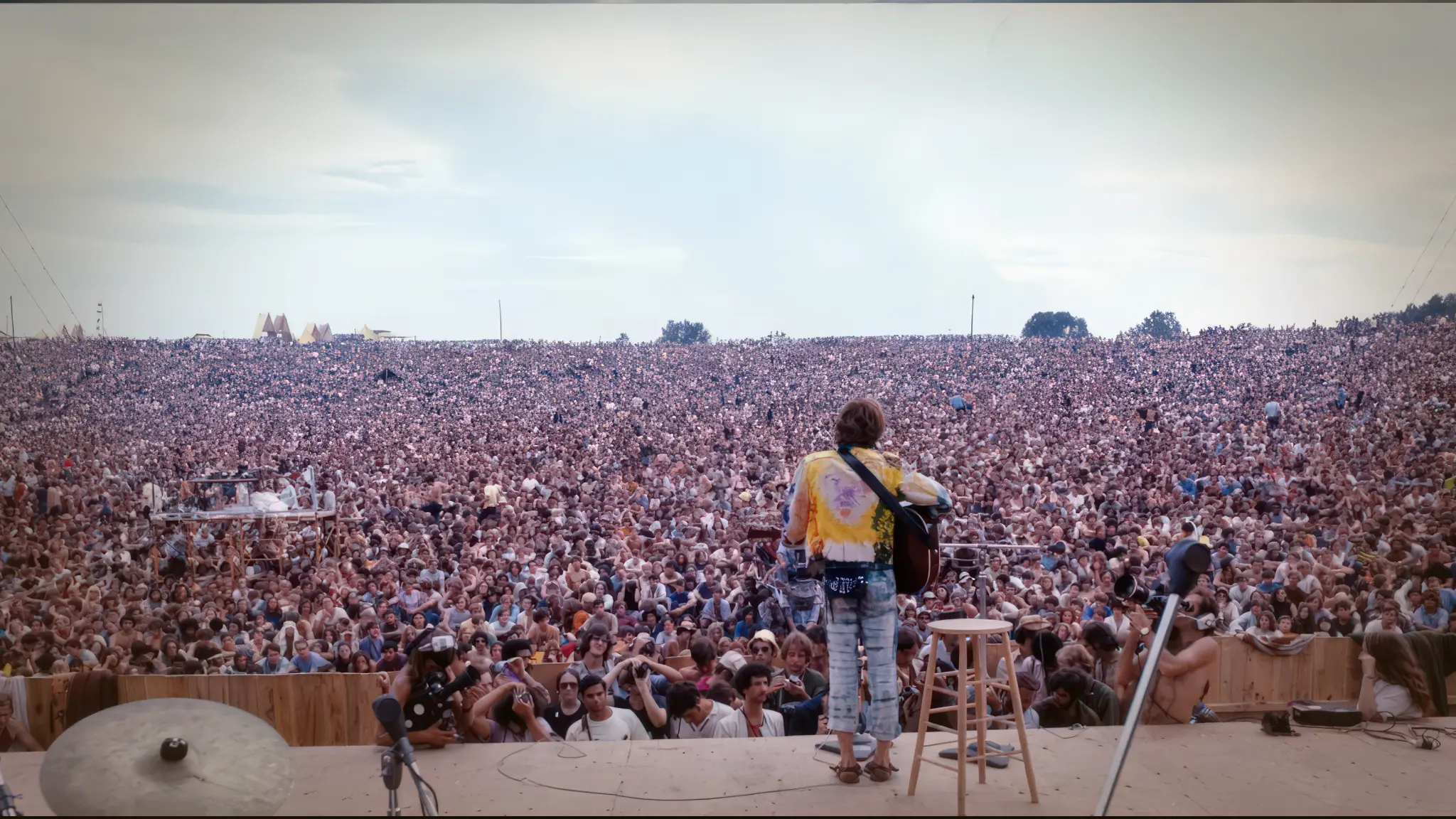
All of the fly-on-the-wall style documentaries in this list are a celebration of the foresight of the filmmakers to know to buy a lot of film and to film everything because something special was about to happen. Or indeed because an egotist told them it was going to happen and be the biggest this or that in history. The egotist in the case of Woodstock is Michael Lang. A dashing, curly-haired, shirtless young lad out of central casting who speeds in and out of frame on his motorbike. As one of the main organisers of the world’s most famous rock event, his screen time leaves you wanting more. He’s the kind of guy you hate and admire in equal measure. To get truly into his head, however, it is worth following this film with the documentary made about the absolutely apocalyptic Woodstock ’99. It is clear from his contributions to this film that his nonchalance about organising near-human catastrophes is born out of sheer fanaticism.
Whilst I find frustration in watching this film with a modern need for “if only we could see more of what was going on behind the scenes,” it is primarily a documentation of the finest American musicians of their time in the finest form under the worst circumstances. Only during an age where performers performed 200–300 times a year could you expect such defining exhibitions of their art form in the face of such adversity. Classic performance after classic performance after infamous performance (I cite Santana’s 16-year-old drummer soloing for almost the entirety of the set because the rest of the band were too high) by the greats of their time. Joan Baez, Sly & The Family Stone, Jimi Hendrix, The Who, Joe Cocker, Janis Joplin — all playing out of their skins whilst a humanitarian disaster unfolded before them. With a running time of 224 minutes, it makes for an absolute epic relic of an era at the end of that era.
3. Kanye – Jeen Yuhs
If there’s one debate that I frequently come to loggerheads with, it is the question of how much luck plays a part in success. Having met countless music-makers of all walks and on all rungs of the “success” ladder, I see nothing but common patterns that are wholly predictable, which belie the apprehension that luck is the determining factor. There’s an often-quoted saying by Seneca: “Luck is when preparation meets opportunity.” But I find this to be a circular fallacy. If there were a single predictor or ingredient to success from my standpoint, that is tenacity. If luck strikes an individual more than others, it’s because they are striving to find those opportunities. If they are succeeding where others fail, it is because they have failed more (and in so doing, have practised more). Where musical titans, icons, legends are concerned, these are the Olympians. Rare specimens who try harder, work harder, practise more, fail more, travel more, beat down doors more — but also listen and learn from others. Compare themselves and judge their own work. Hold on and believe in what they do, whilst also being able to reject and abandon it when it is not to a standard that they are capable of recognising beyond the doses of dopamine our egos use to mask our own needs to better ourselves. There are titans that have gone before Kanye, and future generations will be anointed with legends of their own. Where we are lucky as viewers is by the rare time in history where cameras became small, affordable, whilst still being unusual. A time before we became more eternally aware of the monitoring of our behaviour and that the records we are all making of our lives would be viewable by all and therefore manufactured and contrived. This documentary is an extraordinary record of Kanye’s ascent and what it truly takes to fight your way to the top.
I pick it as my number 3 because of its efficacy as a tonic, a tincture if you will, to calm the ills of envy, despair or indeed a sense of failure. Whilst I would never dream of treading on the toes of ambition, our industry or desires surrounding it are a war of attrition with a Somme-like carnage of disappointed combatants. When presented with someone who is feeling blue because their hopes of becoming the next Kanye, Beyoncé or Quincy were never realised, I point them to this film. “Do you know what it takes to become one of them?!!!”
The first two episodes serve as an amazing historical insight into the ascendancy of someone with the tenacity of an individual like Kanye. On first watching the third episode was more of a struggle. It seemed poorly edited, an adjunct, a second squeezing of the teabag. However, on second viewing, it is in direct counterpoint to the first half of the series. It poses the question, and plays it out almost in real-time: what happens when that force of nature — never sleeping, countless corridors, banging down doors, favours for people who didn’t deserve it, working for people who don’t pay him for it — what happens to someone when they have ‘everything,’ yet that drive continues? It acts not as an epilogue but a prologue to how and why, depending on your opinions of him, the wheels came off the wagon after these cameras stopped rolling.
Jesus walks.
2. Amadeus.
It’s a total work of fiction but who cares. Nothing short of a masterpiece, Milos Forman encapsulates the magic of making music — how it sometimes feels like we are conduits for a higher power to channel heavenly forms of expression onto a page for an orchestra to play. Originally a hit National Theatre production where the orchestra were situated on stage and played along with the dialogues to synchronise the creative process, to enable us to hear what composers hear and how they translate that to the page. It centres around the short life of Wolfgang Amadeus Mozart, a prodigious human being by any measure — and a fictional rivalry between him and his nemesis, court composer Antonio Salieri. Forman’s exquisite production, filmed behind the Iron Curtain in former Czechoslovakia, pre-stag-do Prague. The excellent behind-the-screen documentary documents how, for larger crowd scenes, it was quite apparent which background artists were in fact secret-service plants. Whilst the film presents itself as a biopic of Mozart, the central figure and narrator of the piece is a tour de force performed by F. Murray Abraham (who won an Oscar for his portrayal). With the stuck-in-time backdrop of Prague, lavish locations, palaces, set dressing, stunning costumes and even attention paid to a crew confectioner who ensured the film represented affluence through the court-classes’ consumption of period sugary delights. It is one of the finest period dramas ever made.
However, its true triumph lies in the representation of Mozart’s work — not only in the many onscreen performances but also its genesis. No film has ever come close in the mastery of the medium of music and onscreen synchronisation. With the music pre-recorded by Neville Marriner and piped through to the actors via earpieces hidden in their chalk wigs, coupled with a career-defining performance by Abraham as narrator, Forman manages to truly conjure the sense of frustration, wonder and bewilderment experienced when endeavouring to conjure music from the air and somehow tap into the heavens.
1. Spinal Tap
15th February 1971 — the world of numbers was tipped on its head in the UK when they finally went decimal. 4th May 1984 was the day the music industry went undecimal or udinary. Everything from this point on would be counted in reference to the number 11. The day? It was the day the film Spinal Tap (née This Is Spinal Tap) was premiered. The day that Nigel Tufnel uttered what would become the most universal in-joke in the lexicon of music: “These amps go to eleven.” If you see a dial on a bit of music kit, an utterance of “we’re gonna take it to eleven,” even the volume dial on BBC’s iPlayer app — it’s down to this utterance.
Spinal Tap is an epistolary film (dubbed “Rockumentary”) centred around the agonising demise of middle-aged rockers Spinal Tap trying to break America. Directed by Rob Reiner with such masterful command of the idiom of non-fictional fly-on-the-wall style biopics and improvised performances by American and Canadian actors wielding some of the most accurate mid-Atlantic accents of the era ever committed to celluloid by North American performers. It is often mistaken for a real-life documentary.
But for musicians, or anyone who has been in, or worked with bands, it is a tapestry of detailed observation, technical accuracy and psychological veracity. It is a work of fiction that is truer than any non-fictional counterpart. From the seething rivalry of lead guitarist and frontman, to the parade of drummers meeting untimely ends. From disasters on stage and off, to puerile interviews. The film is as pitch-perfect as the actors performing the music. The film’s brilliance in this technical respect often eclipses its comedic brilliance with comedy lyrics that are actually funny and one-liner parapets that permeate through generations of music makers.
-
None more black.
-
The saddest of all keys (in reference to D minor and a ballad being penned called “Lick My Love Pump”)
-
Big bottoms drive me out of my mind, how can I leave this behind.
-
You know where you stand in a hell hole.
-
Mime is money (uttered in a cameo by Billy Crystal).
-
Money talks and bullshit walks.
-
They put too much Dobly [sic] on it.
-
Shit Sandwich.
-
So we became The New Originals.
-
Choked on somebody else’s vomit.
-
You can’t dust vomit for prints.
-
Died in a bizarre gardening accident.
Watched contemporaneously, the references (now lost for most) could be drawn directly. But what makes Spinal Tap live on is the universal connection for anyone who has ever been in a band. Stage malfunctions, interfering partners (the part of Janine probably one of the best-observed characterisations), bad riders, poor billing and radio mics are not just experienced by A-listers, but all listers.